
Leaving Your Employer – Should You Take Your Pension?

When you leave an employer, one of the biggest financial decisions you may face is what to do with your pension. For many employees and executives, the pension represents years of savings and future income security. But when offered the option to take the value of the pension today, it can feel overwhelming to decide whether to leave it where it is or transfer it out. Let’s walk through the key considerations so you can make an informed choice.

What is a Pension Plan?

A pension is a retirement savings arrangement set up by your employer. There are two main types: defined contribution and defined benefit. With a defined contribution plan, both you and your employer contribute money, and the balance depends on investment performance. With a defined benefit plan, your future income is pre-determined based on things like your years of service and average salary. Many Canadians leaving an employer with a defined benefit plan will be faced with the decision of whether to keep the pension or “commute” (cash out) its value.

Defined benefit pensions are attractive because they provide predictable lifetime income. This predictability can give peace of mind. On the other hand, defined contribution plans shift the investment risk to you, since your eventual income depends on how the funds grow over time.

Know Your Pension Options

When you leave your employer, your options depend on the type of plan. With a defined contribution plan, you’ll typically move the money into your own locked-in retirement account or buy an annuity that provides income for life. With a defined benefit plan, you can either:

  • Leave the pension with your former employer, collecting a guaranteed monthly payment at retirement.
  • Take the commuted value (the lump sum representing the present value of future payments) and transfer it to a locked-in retirement account.

Both options have trade-offs. Leaving the pension may give you peace of mind with guaranteed income for life. Commuting gives you control over the investments but shifts the risk to you. The decision also has implications for your family. Unlike a commuted pension, which can be passed on to heirs, most defined benefit pensions end upon death, except for survivor benefits that may be included.

Key Considerations Before Deciding

This decision is highly personal and depends on several factors:

  • Longevity: If you expect to live longer than average, staying in the pension may make sense because it ensures you don’t outlive your money.
  • Stability of the employer’s plan: Some pensions are well-funded, while others face challenges. If you have doubts about whether the company will remain strong enough to pay pensions in the future, taking the commuted value may provide more security.
  • Need for predictable income: A pension offers steady, reliable payments. If you’d feel more comfortable knowing exactly what you’ll receive each month, this could be valuable.
  • Market risk: If you commute your pension, your retirement income will depend on market returns. That could mean growth, but also the possibility of running out of money if markets perform poorly or if withdrawals are too high.
  • Estate planning: Pensions typically stop at death (with limited survivor benefits). If leaving money to your heirs is important, a commuted pension gives more flexibility.

It’s important to weigh these factors against your lifestyle, your other sources of income (such as CPP, OAS, RRSPs, or TFSAs), and your comfort with risk.

How Much Can You Transfer?

When you choose to take the commuted value, the Income Tax Act sets a maximum amount that can be transferred tax-deferred into a locked-in retirement account (LIRA). The formula depends on your annual pension amount and a factor based on your age. Anything above this maximum must be taken as taxable income in the year you leave your employer. This can create a significant tax bill. Planning ahead with strategies like using RRSP room or your spouse’s RRSP can help soften the tax hit. In some cases, contributing to a Tax-Free Savings Account (TFSA) may also be beneficial.

Unlocking Pension Money

Funds in a LIRA remain locked until retirement, but there are exceptions. Depending on your province, you may be able to unlock money earlier if you face financial hardship, move out of the country, or have a shortened life expectancy. At retirement age, a LIRA typically converts into a Life Income Fund (LIF), which provides a stream of income but still follows government rules for minimum and maximum withdrawals.
Some provinces allow partial unlocking of a LIRA once you reach a certain age, which can improve flexibility.

Additional Factors to Keep in Mind

There are also tax and income-splitting considerations. Pension income can often be split with a spouse, reducing household taxes. However, this benefit works differently depending on whether you keep the pension or commute it. If you keep your pension, income splitting is available immediately when payments begin. If you commute and move the funds into a LIF or RRIF, income splitting usually becomes available only at age 65.

Indexing and bridge benefits are also worth reviewing. Some pensions offer cost-of-living increases or bridge payments until government benefits like CPP or OAS begin. These can significantly impact the overall value of staying in the pension.

Final Thoughts

Deciding what to do with your pension when leaving an employer is one of the most important retirement choices you’ll face. Keeping the pension can give you guaranteed income for life, while commuting it offers flexibility and control, but with added risks and potential tax costs. The right decision depends on your personal goals, health, family needs, and comfort with investment risk.

If you’re unsure, take the time to speak with us before making your decision. A pension may be one of your largest assets, and the choice you make could shape your retirement for decades.
RDSP Explained 2026

brandableContent

Registered Disability Savings Plan (RDSP) Explained

Planning for the long-term financial security of individuals with disabilities is a priority for many families. The Registered Disability Savings Plan (RDSP) is one of the most powerful savings tools available in Canada, offering tax-deferred growth and generous government contributions to help build financial security over time.

If you or a loved one qualifies for the Disability Tax Credit (DTC), the RDSP can play a key role in creating a long-term financial cushion for future needs.

What is the RDSP?

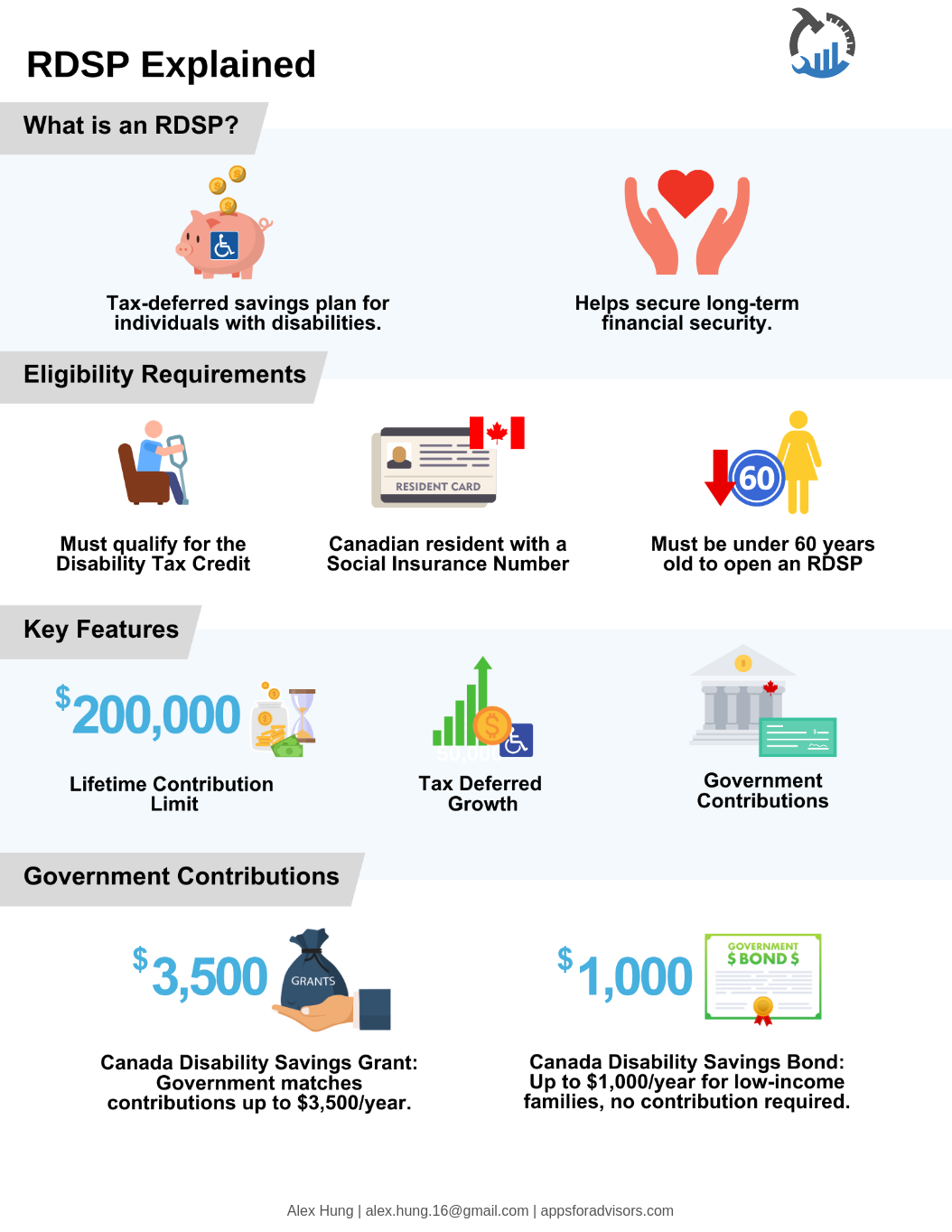
The RDSP is a savings plan designed to help individuals with disabilities save for their long-term financial security. It is a tax-deferred account, which means the investments grow tax-free while inside the plan, though taxes may apply upon withdrawal. The RDSP offers government assistance through the Canada Disability Savings Grant and the Canada Disability Savings Bond, significantly boosting savings for those who qualify.

Key Features of RDSP

  • Tax-Deferred Growth- Investments grow without annual taxation while inside the plan.
  • Government Contributions- Eligible beneficiaries may receive grants and bonds from the federal government.
  • Flexible Contributions- Contributions can be made by the beneficiary, parents, family members, or friends.
  • Lifetime Contribution Limit- Up to $200,000 in personal contributions, with no annual contribution limit.

Eligibility Criteria for RDSP

To be eligible for the RDSP, the beneficiary must:

  • Qualify for the Disability Tax Credit (DTC)
  • Be a Canadian resident with a valid Social Insurance Number (SIN)
  • Be under age 60 when the plan is opened
  • Receive government grants and bonds only until the end of the year they turn 49

Government Contributions Explained

Canada Disability Savings Grant (CDSG): The government will match contributions up to 300%, 200%, or 100%, depending on the beneficiary’s family income and the contributions made.

The CDSG provides matching government contributions based on family income, which is indexed annually.

  • Lower- and modest-income families may receive matching grants of up to 300% on contributions
  • Higher-income families may receive a 100% match on eligible contributions
  • Maximum annual grant: $3,500
  • Lifetime grant maximum: $70,000

Even small annual contributions can result in substantial government support over time.

Canada Disability Savings Bond (CDSB):

The CDSB is designed to support individuals with lower family income and does not require personal contributions.

  • Eligible beneficiaries may receive up to $1,000 per year
  • Bond amounts are determined on a sliding scale based on family income
  • Lifetime bond maximum: $20,000

Why Open an RDSP?

The RDSP is one of the most effective ways to save for individuals with disabilities, providing them with long-term financial security. By taking advantage of tax-deferred growth and government contributions, families can ensure that their loved ones have financial support when they need it most.

The RDSP is one of the most powerful and underutilized savings tools in Canada for families and individuals living with disabilities. It offers:

  • Long-term financial growth
  • Tax advantages
  • Up to $90,000 in government contributions
  • Financial security for adulthood and retirement

By contributing early and consistently, even modest contributions can lead to substantial growth thanks to government support and tax-deferred compounding.

Contact us today. 

Sources: . “Registered Disability Savings Plan (RDSP).” Canada Revenue Agency: https://www.canada.ca/en/revenue-agency/services/tax/individuals/topics/registered-disability-savings-plan-rdsp.html

“Canada Disability Savings Grant and Bond.” Government of Canada: https://www.canada.ca/en/revenue-agency/services/tax/individuals/topics/registered-disability-savings-plan-rdsp/canada-disability-savings-grant-canada-disability-savings-bond.html

2022 Federal Budget Highlights

Federal Budget 2022 – Highlights

On April 7, 2022, the Federal Government released their 2022 budget. We have broken down the highlights of the financial measures in this budget into the following different sections:

  • Housing

  • Alternative minimum tax

  • Dental care

  • Small businesses

  • Tradespeople

  • Canada Growth Fund

  • Climate

  • Bank and insurer taxes

Housing

There were several tax measures related to housing introduced in the budget.

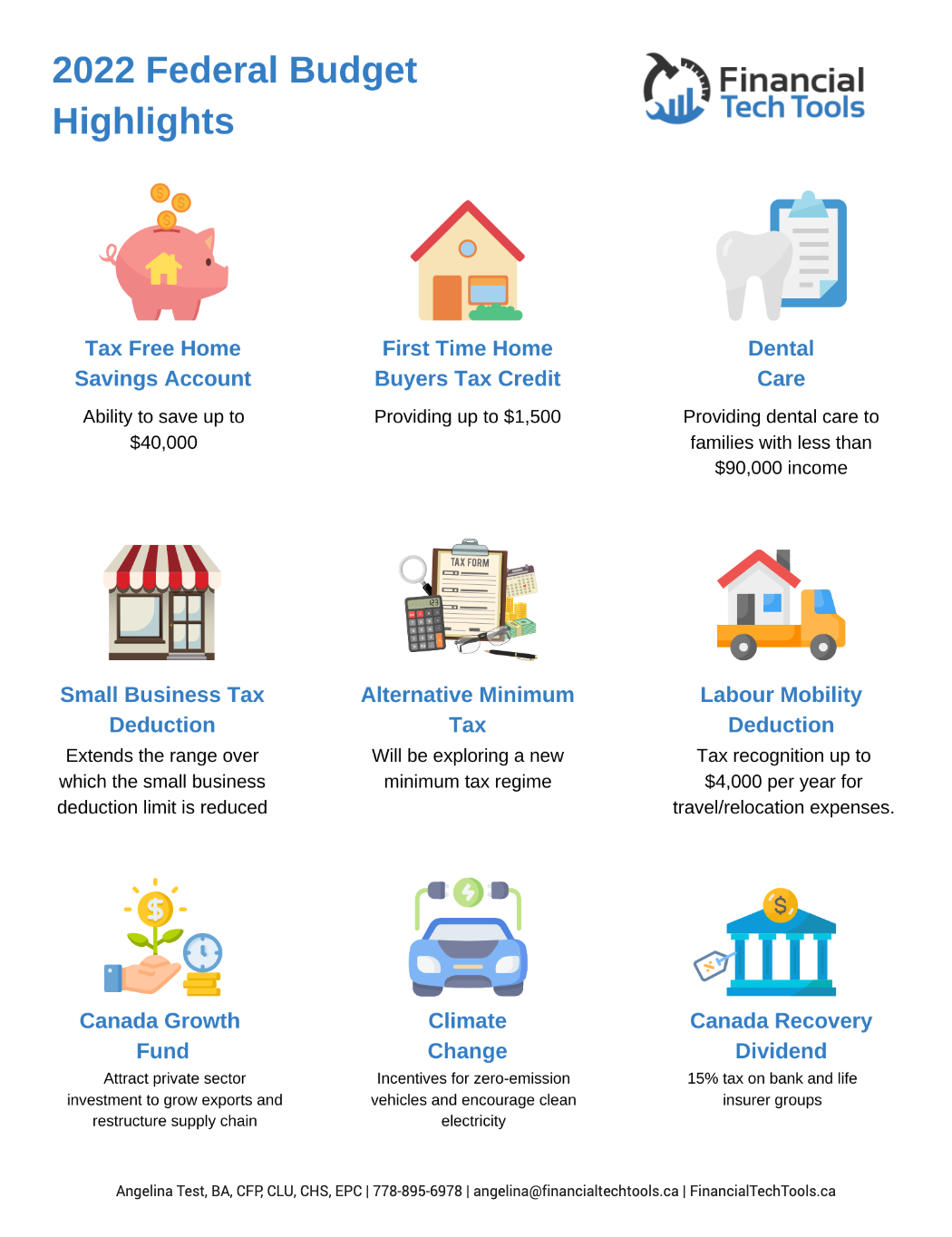
Budget 2022 introduced a new kind of savings account – a Tax-Free First Home Savings Account (FHSA).

These are the key things you need to know about the new FHSAs:

  • You must be at least 18 years of age and a resident of Canada to open an account. You must also not currently own a home or have owned one in the previous four calendar years.

  • You can only open and use an FHSA once, and you must close it within a year after your first withdrawal.

  • Contributions are tax-deductible, and income earned in an FHSA will not be either while it is in the account or when you withdraw it.

  • There is a lifetime contribution limit of $40,00, with an annual contribution limit of $8,000. You can’t carry contribution room forward.

  • If you don’t use the funds in your FHSA within 15 years of opening it, you can transfer them to an RRSP or RRIF tax-free. Transfers to an RRSP do not impact your RRSP contribution room.

Two existing tax credits were increased, and a new one was introduced:

  • The First-Time Home Buyers’ Tax Credit amount was increased from $5000 to $10,000, giving up to $1,500 in direct support to home buyers. This tax credit applies to all homes purchased on or after January 1, 2022.

  • The annual expense limit for the Home Accessibility Tax Credit has been increased to $20,000 for 2022 and subsequent tax years.

  • A new tax credit, the Multigenerational Home Renovation Tax Credit, was introduced, which will start in 2023. This tax credit is a 15% refundable credit for eligible expenses up to $50,000 (maximum tax credit is $7,500) for constructing a secondary suite for a senior or an adult with a disability to live with a qualifying relative.

Budget 2022 proposes new rules, effective January 1, 2023, that anyone who sells a residential property they have held for less than 12 months would be subject to full taxation on their profits as business income. However, there will be some exemptions to these rules due to life events such as a death, disability, the birth of a child, a new job, or a divorce.

Budget 2022 also announces restrictions that would help ensure that Canadians, instead of foreign investors, own housing. A two-year ban will be introduced on non-residents buying residential property, with some exceptions, such as individuals who have work permits and are living in Canada.

Alternative Minimum Tax

In Canada, the top federal tax rate is 33% and starts at an income of $221,708. However, many high-income filers end up paying less tax than this due to tax deductions and tax credits.

The goal of the Alternative Minimum Tax (AMT), which has been around since 1986, is to ensure high-income Canadians are paying their fair share of taxes. However, it has not been substantially updated since it was introduced. In Budget 2022, the government indicated they would be investigating changes to the AMT, which will likely be disclosed in the fall 2022 economic update.

Dental Care

For many Canadians without private coverage, going to the dentist is too expensive. Budget 2022 commits $5.3 billion to provide dental care for Canadians with family incomes of less than $90,000 annually. Coverage will start for children under 12 this year and expand to children under 18, seniors and those living with a disability in 2023, with the program will be fully implemented by 2025.

Small Businesses

Small businesses currently have a 9% tax rate on the first $500,000 of taxable income (compared to the corporate tax rate of 15%). However, after a small business’ capital employed in Canada reaches $15 million, it is no longer eligible for the 9% tax rate.

Budget 2022 proposes gradually phasing out the small business tax rate so that businesses are not discouraged from expanding. The new cut-off for the lower tax rate will be $50 million.

Budget 2022 also includes a proposal to create an Employee Ownership Trust. This would be a new, dedicated trust under the Income Tax Act to support employee ownership.

Tradespeople

Budget 2022 introduces the Labour Mobility Deduction. This would allow eligible tradespersons and apprentices to deduct up to $4,000 a year in eligible travel and temporary relocation expenses.

Budget 2022 also commits to providing $84.2 million over four years to double funding for the Union Training and Innovation Program, which would help 3,500 apprentices from underrepresented groups each year.

Canada Growth Fund

Budget 2022 introduces a new Canada Growth Fund, with the goals of both diversifying our economy and helping achieve our climate goals.

The Canada Growth Fund aims to attract considerable private sector investment, support the restructuring of vital supply chains, and bolster our exports. The Canada Growth Fund will also provide backing to reduce our emissions and invest in the growth of low-carbon industries.

Climate

Budget 2022 continues to confirm the government’s commitment to fighting climate change. It commits $1.7 billion over five years to extend the Incentives for Zero-Emission Vehicles Program until March 2025 and also provides funding to create a national network of electric vehicle charging stations.

Budget 2022 also commits $250 million over four years to support the development of clean electricity, including inter-provincial electricity transmission projects and Small Modular Reactors.

Bank And Insurer Taxes

Budget 2022 introduced a new financial measure called the Canada Recovery Dividend. Banks and insurers will have to pay a one-time, 15% tax on 2021 taxable income above $1 billion. This tax will be payable over five years.

Budget 2022 also proposes increasing the tax rate on income above $100 million for banks and insurers to 16.5% (currently 15% for other corporations).

Wondering How This May Impact You?

If you have any questions or concerns about how the new federal budget may impact you, call us – we’d be happy to help you!